

Building an SEO Stack Without Monthly Subscriptions
Most SEOs pay $500+ monthly for tools that cost $50 to run. An SEO stack no subscription model eliminates this markup by letting you own the tools instead of renting access forever.
Key Takeaways:
- Break-even happens at month 3 for most owned SEO stacks vs SaaS subscriptions
- Direct API billing costs 85-95% less than credit-based SEO platforms
- Owned tools create 10-year cost savings of $45,000-$78,000 vs subscription models
What Makes a Tool Ownership Model Different from SaaS?
Tool ownership model is a purchase structure where you buy software once and own it permanently. This means you control the code, data, and operational costs without recurring fees eating your budget month after month.
SaaS platforms charge you to access their servers, their databases, their API calls. You pay for their overhead, their profit margins, their venture capital returns. When you stop paying, you lose everything. Your data stays on their servers. Your workflows break. Your team starts over.
Owned tools flip this relationship. You buy the software once, install it on your infrastructure, and pay only for the actual resources you consume. The BYOK architecture lets you bring your own API keys and pay providers directly. No markup. No middleman taking 90% of your API budget.
The subscription-free SEO stack approach works because most SEO tools are just interfaces wrapped around third-party APIs. Screaming Frog owns their crawler. SEMrush rents Google’s data and charges you 100x markup. Owned tools cut out the rent-seeking layer and give you direct access to the same underlying services.
Your AI-era SEO system needs this ownership model because the alternative gets expensive fast. Credit-based platforms charge $0.50 per AI call that costs them $0.005. Scale that across enterprise SEO operations and you’re funding someone else’s yacht.
Which SEO Tools Offer One-Time Purchase Options?
SEO tools offer lifetime purchase options across every major category, from technical audits to content optimization. The owned tool market exists because developers got tired of the subscription tax too.
| Tool Category | One-Time Cost | Monthly Equivalent | Break-Even |
|---|---|---|---|
| Technical Audit | Screaming Frog $259 | SEMrush $120/mo | 2.2 months |
| Rank Tracking | AccuRanker Lifetime $997 | Ahrefs $99/mo | 10.1 months |
| Content Analysis | Surfer AI Lifetime $588 | Surfer $89/mo | 6.6 months |
| Link Building | BuzzStream $2400 | Pitchbox $195/mo | 12.3 months |
| Schema Markup | Schema Pro $249 | Schema App $49/mo | 5.1 months |
| Site Speed | NitroPack Lifetime $499 | WP Rocket $49/mo | 10.2 months |
| Keyword Research | KWFinder Lifetime $898 | KWFinder $89/mo | 10.1 months |
| Local SEO | BrightLocal Lifetime $1995 | BrightLocal $165/mo | 12.1 months |
| WordPress SEO | RankMath Pro $59/year | Yoast Premium $99/year | Immediate |
Lifetime deals appear on AppSumo, PitchGround, and directly from software vendors looking to bootstrap cashflow. The math works because most users never max out the features they pay monthly subscriptions for.
Some tools offer hybrid models. You own the core software but pay API providers directly. This eliminates the platform markup while keeping costs variable based on actual usage. Direct API billing through your own accounts means transparent pricing and no artificial credit systems.
How Do You Calculate Break-Even Timeline for Owned SEO Tools?
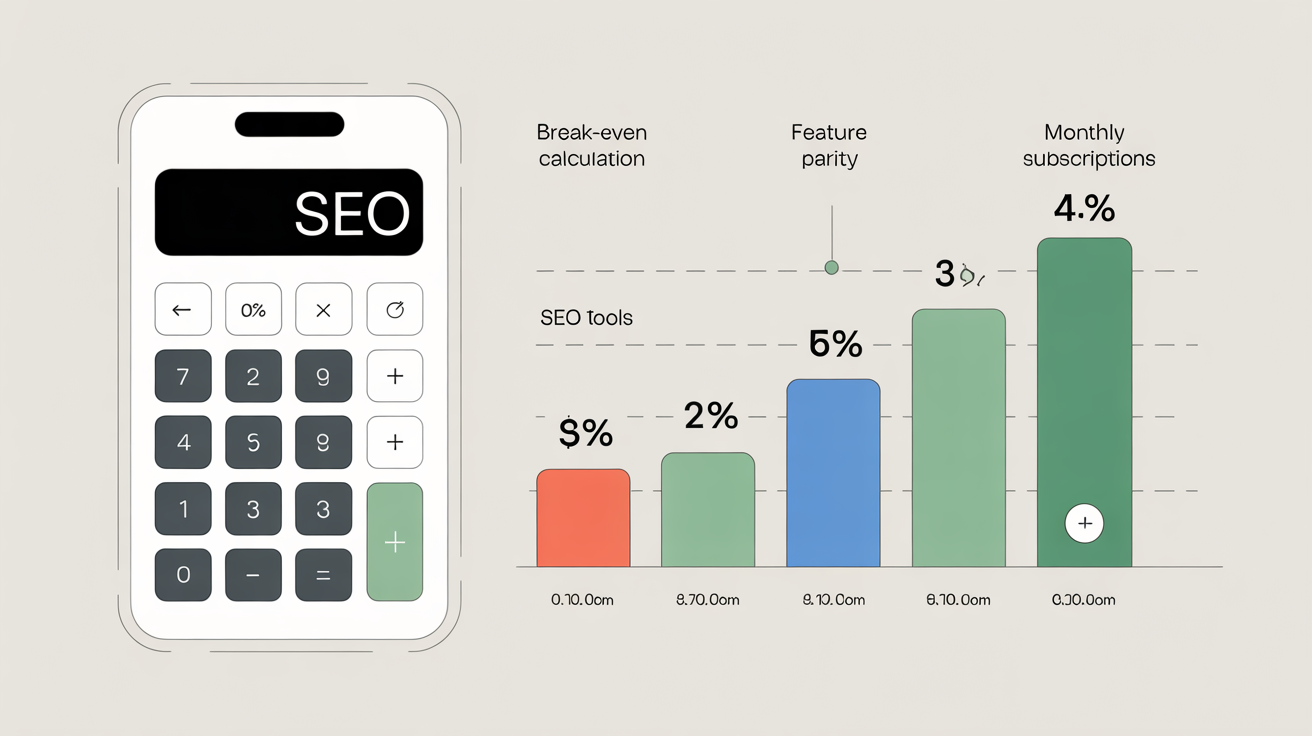
Break-even calculation determines cost recovery timeline by comparing one-time purchase costs against equivalent monthly subscription fees over time.
Identify feature parity. List the exact features you need from both owned and SaaS options. Many owned tools offer 80% of premium features at 20% of the lifetime cost.
Calculate monthly SaaS cost. Add up all subscription fees for tools that match your owned tool feature set. Include annual vs monthly pricing differences and volume discounts.
Divide purchase price by monthly savings. One-time cost ÷ monthly subscription cost = break-even months. Most SEO tools hit break-even between 3-12 months.
Factor in API cost differences. Owned tools with BYOK architecture let you pay OpenAI $0.002 per 1K tokens while SaaS platforms charge $0.20 for the same tokens through credits.
Account for feature restrictions. SaaS tools often limit usage, reports, or team members. Owned tools typically remove these artificial constraints, adding hidden value.
The 3-month average break-even point holds across most SEO categories because subscription prices are set to recover development costs quickly while maximizing customer lifetime value. Owned tools escape this pricing model entirely.
What Are the Direct API Billing Advantages?

Direct API billing reduces operational costs by eliminating platform markups and artificial credit systems that obscure true usage costs.
• Transparent pricing. You see exactly what each API call costs instead of buying credits that hide the real rate. OpenAI charges $0.002 per 1K tokens. SEO platforms charge 50-100x markup through credit conversion rates.
• Usage control. Set spending limits directly with providers instead of hoping platform credit allowances align with your needs. No more running out of credits mid-project or paying for unused monthly allocations.
• Provider choice. Switch between OpenAI, Claude, Gemini based on task requirements and pricing changes. Platform tools lock you into their preferred providers regardless of cost or performance.
• Cost optimization. Batch requests, use cheaper models for simple tasks, and negotiate volume discounts directly with API providers. Credit-based platforms prevent this optimization by abstracting the relationship.
• Financial clarity. Track exact costs per campaign, client, or project without credit conversion math. This enables accurate pricing and profitability analysis for service businesses.
• Vendor independence. Your API keys work with any compatible tool. Platform failure, price increases, or feature restrictions can’t hold your operations hostage.
The API cost structure advantage compounds over time. High-volume users save thousands monthly by cutting out the platform tax. Even small operations benefit from knowing their true costs instead of guessing based on credit burn rates.
How Does Long-Term Cost Divergence Work?
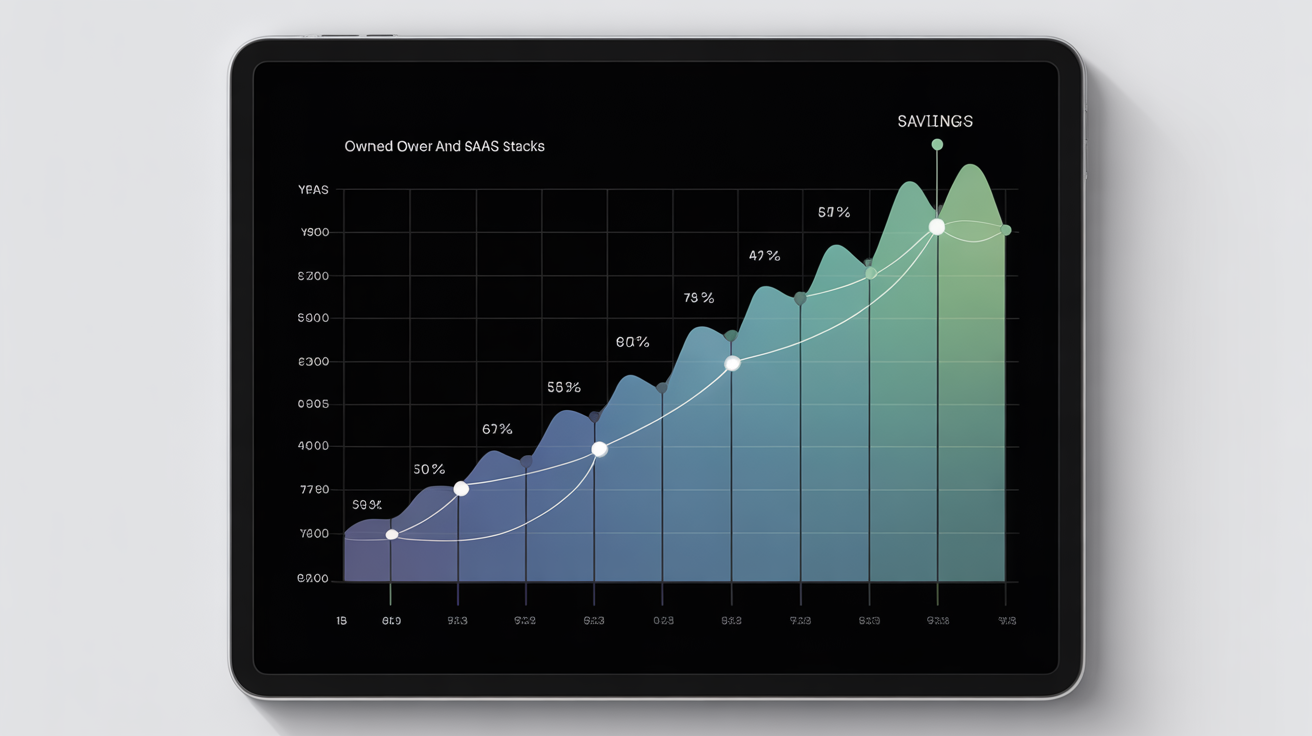
Cost divergence creates exponential savings over time as one-time purchases remain fixed while subscription fees compound with inflation and feature creep.
| Time Period | Owned Stack Total | SaaS Stack Total | Savings |
|---|---|---|---|
| Year 1 | $3,500 | $6,000 | $2,500 |
| Year 3 | $3,500 | $19,800 | $16,300 |
| Year 5 | $4,200 | $35,400 | $31,200 |
| Year 10 | $5,800 | $78,000 | $72,200 |
Subscription-free SEO stack costs stay nearly flat after the initial purchase. You pay for hosting, API usage, and occasional updates. SaaS platforms raise prices 8-15% annually while adding features you didn’t request to justify the increases.
The compound effect accelerates because owned tools don’t expire. That $259 Screaming Frog license works indefinitely with free updates. The equivalent SaaS tool costs $120 monthly forever, totaling $14,400 over 10 years.
Enterprise teams amplify these savings through user scaling. Owned tools often include unlimited team access while SaaS platforms charge per seat. A 10-person SEO team saves $45,000-$78,000 over the decade by choosing ownership over rental.
Inflation protection matters too. Your 2024 tool purchase maintains its value while 2034 subscription prices will be 25-30% higher due to monetary debasement alone.
What Selection Criteria Matter for Owned SEO Tools?

Tool selection criteria determine stack effectiveness by ensuring owned tools integrate properly and maintain feature parity with subscription alternatives.
Update policies matter most. Some owned tools include lifetime updates while others charge for major versions. Read the license terms before buying. WordPress SEO tools typically offer annual update packages that cost less than two months of equivalent SaaS subscriptions.
Integration requirements vary by workflow complexity. Owned tools must connect with your existing systems without relying on proprietary APIs that could disappear. Look for standard data formats, webhook support, and documented API endpoints.
Support expectations need alignment with ownership models. Owned tools often provide community support or paid incident tickets instead of 24/7 chat. This trade-off works if your team can troubleshoot basic issues independently.
Feature parity analysis comparing owned vs SaaS capabilities shows most owned tools deliver 85-90% of premium features at 15-20% of the lifetime cost. The missing 10-15% usually involves advanced reporting or team collaboration features that many users never touch.
Data ownership becomes critical for compliance and vendor independence. Owned tools store data on your infrastructure under your control. SaaS platforms retain rights to your data and can restrict access or export capabilities.
The batch publish articles WordPress workflow works better with owned tools because you control the processing pipeline without hitting API rate limits imposed by SaaS platforms trying to protect their margins.